

How to ensure the roundness of 12.20.35mm round holes?
Oct 14, 2025
Leave a message
As a supplier of 12.20.35mm round holes, ensuring the roundness of these holes is of utmost importance. The roundness of holes directly affects the functionality and aesthetics of the products where they are used. In this blog, I will share some key strategies and techniques that we employ to guarantee the high - quality roundness of our 12.20.35mm round holes.
Understanding the Importance of Roundness
Before delving into the methods of ensuring roundness, it is essential to understand why it matters. In industries such as manufacturing, construction, and engineering, precise round holes are crucial. For example, in the case of mechanical parts, round holes are used for the installation of shafts, bearings, or other components. If the holes are not round, it can lead to improper fitting, increased wear and tear, and ultimately, the failure of the entire system. In construction, round holes in materials like gypsum boards are used for various purposes such as ventilation, wiring, or the installation of fixtures. Poor roundness can compromise the structural integrity and the overall appearance of the building.
High - Precision Machining Equipment
One of the primary factors in ensuring the roundness of 12.20.35mm round holes is the use of high - precision machining equipment. We invest in state - of - the - art drilling and punching machines that are capable of achieving extremely accurate hole diameters and roundness. These machines are equipped with advanced control systems that can precisely regulate the speed, feed rate, and depth of the drilling or punching process.


For instance, our CNC (Computer Numerical Control) drilling machines are programmed to execute the drilling operation with micron - level accuracy. The computer - controlled system ensures that the drill bit moves in a perfectly circular path, resulting in round holes with minimal deviation from the desired diameter. The spindle of the drilling machine is also carefully calibrated to maintain a stable rotational axis, which is essential for achieving round holes.
Quality Control of Raw Materials
The quality of the raw materials used also plays a significant role in ensuring hole roundness. We source our materials from trusted suppliers and conduct thorough inspections before using them in the production process. For example, if we are manufacturing gypsum boards with 12.20.35mm round holes, we check the density, hardness, and homogeneity of the gypsum.
Inhomogeneous materials can cause the drill bit to deviate from its intended path during the drilling process, resulting in non - round holes. By ensuring that the raw materials are of consistent quality, we can minimize the risk of such issues. Additionally, we store the raw materials in a controlled environment to prevent any damage or deformation that could affect the hole - making process.
Proper Drill Bit Selection
Selecting the right drill bit is crucial for achieving round holes. Different materials require different types of drill bits. For 12.20.35mm round holes in various materials such as metal, wood, or gypsum, we carefully choose the appropriate drill bit based on the material's properties.
For example, when drilling holes in metal, we use high - speed steel (HSS) or carbide drill bits. These drill bits are hard and can withstand the high cutting forces generated during the drilling process. They also have a sharp cutting edge that can cut through the metal cleanly, resulting in round holes. When working with gypsum boards, we use specialized drill bits that are designed to prevent chipping and cracking of the material. These drill bits have a unique tip geometry that allows for smooth and precise drilling.
Drilling Process Optimization
The drilling process itself needs to be optimized to ensure roundness. We pay close attention to several key parameters during the drilling operation.
First, the speed of the drill bit is carefully adjusted. Too high a speed can cause the drill bit to overheat, which can lead to wear and deformation of the bit, resulting in non - round holes. On the other hand, too low a speed may cause the drill bit to chatter, also affecting the roundness of the hole. We determine the optimal speed based on the material being drilled and the diameter of the hole.
Second, the feed rate is another important factor. The feed rate refers to the rate at which the drill bit advances into the material. A consistent and appropriate feed rate is necessary to ensure that the drill bit cuts through the material evenly, resulting in a round hole. If the feed rate is too fast, the drill bit may break or cause the hole to be out of round. If it is too slow, it can lead to excessive heat generation and poor hole quality.
Inspection and Testing
After the holes are drilled, we conduct a series of inspections and tests to ensure their roundness. We use advanced measuring tools such as coordinate measuring machines (CMMs) and roundness testers. These tools can accurately measure the diameter, roundness, and concentricity of the holes.
Any holes that do not meet our strict quality standards are rejected and re - worked or scrapped. By implementing a rigorous inspection and testing process, we can ensure that only high - quality products with perfectly round 12.20.35mm holes are delivered to our customers.
Application in Gypsum Boards
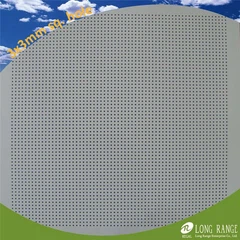
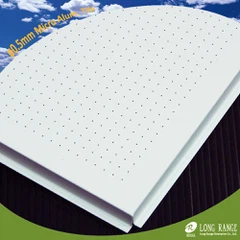
In the construction industry, Gypsum Board 12/20/35R Round Hole is widely used. Our expertise in ensuring the roundness of 12.20.35mm round holes makes our gypsum boards stand out in the market. These round holes in gypsum boards can be used for acoustic purposes, allowing sound to pass through and be absorbed, thus improving the acoustic performance of the room. They can also be used for ventilation, allowing air to circulate freely.
The roundness of the holes in gypsum boards is particularly important for aesthetic reasons. When the holes are perfectly round, the gypsum board looks more professional and high - quality. Our strict quality control measures ensure that the holes in our gypsum boards are not only round but also evenly spaced, enhancing the overall appearance of the product.
Conclusion
Ensuring the roundness of 12.20.35mm round holes is a complex process that requires a combination of high - precision equipment, quality raw materials, proper tool selection, process optimization, and rigorous inspection. As a supplier, we are committed to providing our customers with products that meet the highest quality standards.
If you are in need of products with 12.20.35mm round holes, whether it is for mechanical parts, construction materials, or other applications, we would be more than happy to discuss your requirements. We invite you to contact us for further details and to start a procurement negotiation. Our team of experts is ready to assist you in finding the best solutions for your specific needs.
References
- "Machining Handbook" by Industrial Press Inc.
- "Quality Control in Manufacturing" by ASQ Quality Press.
- "Construction Materials Science" by John Wiley & Sons.
Send Inquiry