


What is the maximum load a 5mm square hole can bear?
Oct 01, 2025
Leave a message
As a supplier of 5mm square holes, I often receive inquiries from customers about the maximum load these holes can bear. This is a crucial question, especially for those in construction, manufacturing, and engineering industries, where the integrity and safety of structures and products rely heavily on the load - bearing capacity of components. In this blog, I will delve into the factors that influence the maximum load a 5mm square hole can bear and provide some insights to help you make informed decisions.
Factors Affecting the Load - Bearing Capacity of a 5mm Square Hole
Material Properties
The material in which the 5mm square hole is made plays a fundamental role in determining its load - bearing capacity. Different materials have distinct mechanical properties such as strength, stiffness, and ductility.
For instance, if the hole is drilled in a high - strength steel plate, the steel's inherent high tensile and compressive strength allows it to withstand significant loads. Steel has a well - defined yield strength and ultimate strength, which are critical parameters in load - bearing calculations. A typical high - strength steel might have a yield strength of around 500 MPa or more. In contrast, a hole in a plastic material like polypropylene will have a much lower load - bearing capacity. Polypropylene is relatively soft and has a lower modulus of elasticity compared to steel, meaning it will deform more easily under load.
The microstructure of the material also matters. For metals, a fine - grained microstructure generally provides better strength and toughness compared to a coarse - grained one. In composites, the orientation and distribution of fibers can significantly affect the load - bearing capacity of a hole.
Hole Geometry
The geometry of the 5mm square hole itself can impact its load - bearing capacity. The sharp corners of a square hole create stress concentrations. When a load is applied, stress tends to accumulate at these corners, which can lead to premature failure. In comparison, a circular hole distributes stress more evenly around its perimeter.
The edge quality of the hole is also important. A rough or jagged edge can act as a stress raiser, reducing the overall load - bearing capacity. A smooth, well - finished edge will allow the material to better resist the applied load. Additionally, the depth of the hole can influence its performance. A shallow hole may have a different load - bearing behavior compared to a deep one, especially when considering shear and bending forces.
Loading Conditions
The type of load applied to the 5mm square hole is a critical factor. There are several types of loading, including static, dynamic, and cyclic loading.
Static loading refers to a constant load applied over a long period. For example, in a building structure, the weight of a ceiling panel supported by a component with 5mm square holes is a static load. Dynamic loading, on the other hand, involves sudden or rapidly changing loads, such as the impact of a falling object. Cyclic loading occurs when a load is applied and removed repeatedly, like the vibrations in a machine.
Each type of loading requires different considerations. Dynamic and cyclic loading can cause fatigue failure, where small cracks initiate at stress concentrations and gradually grow over time, eventually leading to the failure of the component. Static loading mainly depends on the material's strength and the ability of the structure to distribute the load evenly.
Calculating the Maximum Load
To calculate the maximum load a 5mm square hole can bear, engineers typically use a combination of theoretical models and experimental testing.
Theoretical Approaches
One common theoretical approach is based on the principles of mechanics of materials. For a simple case of a plate with a 5mm square hole under uniaxial tension, the stress concentration factor (Kt) can be used. The stress concentration factor accounts for the increase in stress at the hole compared to the nominal stress in the absence of the hole.
The nominal stress (σnom) in a plate under tension is given by the formula σnom = F/A, where F is the applied force and A is the cross - sectional area of the plate. The maximum stress (σmax) at the hole is then σmax = Kt × σnom.
The value of Kt for a square hole in a plate under tension can be found from stress concentration factor charts. Once the maximum allowable stress (σallow) of the material is known (usually based on the yield strength or ultimate strength), the maximum load (Fmax) can be calculated by rearranging the equations.
However, these theoretical models have limitations. They often assume idealized conditions, such as a homogeneous and isotropic material, and do not fully account for real - world factors like material defects and manufacturing tolerances.
Experimental Testing
Experimental testing is an essential part of determining the maximum load a 5mm square hole can bear. This involves fabricating test specimens with 5mm square holes and subjecting them to different types of loading in a laboratory setting.
For static loading tests, a universal testing machine can be used to apply a gradually increasing load until the specimen fails. The load at failure is recorded, and multiple tests are conducted to ensure the reliability of the results.
Dynamic and cyclic loading tests require more specialized equipment, such as impact testers and fatigue testing machines. These tests can simulate real - world conditions and provide valuable data on the long - term performance of the 5mm square hole.
Applications and Considerations
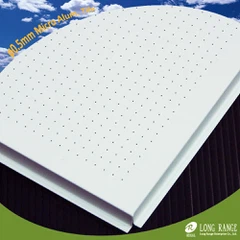
In various industries, the 5mm square hole has a wide range of applications. In the construction industry, Gypsum Board 5x5mm Square Hole is often used for acoustic and decorative purposes. The load - bearing capacity of the holes in gypsum board is important to ensure the stability of the installation.
In manufacturing, 5mm square holes can be found in machine parts, brackets, and fixtures. The load - bearing capacity of these holes is crucial for the proper functioning and safety of the machines.


When using 5mm square holes in your projects, it is important to consider the overall design of the structure or product. The hole should be integrated into a well - designed system that distributes the load effectively. For example, in a truss structure, the members connected through 5mm square holes should be sized and arranged in a way that minimizes stress concentrations.
Conclusion
Determining the maximum load a 5mm square hole can bear is a complex process that involves considering multiple factors such as material properties, hole geometry, and loading conditions. While theoretical calculations can provide a starting point, experimental testing is often necessary to obtain accurate and reliable results.
As a supplier of 5mm square holes, I understand the importance of providing high - quality products that meet your specific load - bearing requirements. Whether you are in the construction, manufacturing, or any other industry, I am here to assist you in choosing the right materials and configurations for your projects.
If you have any questions about the load - bearing capacity of our 5mm square holes or would like to discuss your specific needs, please feel free to contact me. We can engage in a detailed discussion to ensure that you get the best solution for your application.
References
- Timoshenko, S. P., & Goodier, J. N. (1970). Theory of Elasticity. McGraw - Hill.
- Dowling, N. E. (1998). Mechanical Behavior of Materials: Engineering Methods for Deformation, Fracture, and Fatigue. Prentice Hall.
- Shigley, J. E., & Mischke, C. R. (2001). Mechanical Engineering Design. McGraw - Hill.
Send Inquiry