


What is the maximum pressure 12.20.35mm round holes can withstand?
Dec 03, 2025
Leave a message
As a supplier specializing in 12/20/35mm round holes, I've been frequently asked about the maximum pressure these round holes can withstand. This question is crucial for our clients, as it directly impacts the application and performance of our products. In this blog, I'll delve into the factors affecting the pressure - bearing capacity of these round holes and attempt to provide a comprehensive answer.
1. Understanding the Basics of Pressure and Round Holes
Before we dive into the maximum pressure, it's essential to understand some basic concepts. Pressure is defined as the force applied per unit area. When we talk about the pressure a round hole can withstand, we're essentially discussing the amount of force that can be exerted on the material around the hole without causing structural failure.
The size of the round hole plays a significant role. Our 12/20/35mm round holes vary in diameter, and this difference in size affects how the material distributes the pressure. Generally, larger holes are more likely to experience stress concentration at the edges, which can reduce the overall pressure - bearing capacity.
2. Factors Affecting the Pressure - Bearing Capacity
Material Properties
The material from which the product with the round holes is made is the most fundamental factor. For instance, if the material is made of high - strength steel, it can withstand much higher pressure compared to a softer material like aluminum. The material's yield strength, ultimate tensile strength, and ductility all contribute to its ability to handle pressure. A material with high yield strength can resist deformation under pressure, while good ductility allows it to absorb energy before failure.
Hole Geometry
In addition to the diameter, other geometric aspects of the round hole matter. The smoothness of the hole's edge can influence stress distribution. A rough - edged hole may have stress concentrations at the irregularities, which can lead to premature failure under pressure. Also, the spacing between multiple holes is important. If the holes are too close together, the material between them may become too thin to effectively distribute the pressure, reducing the overall pressure - bearing capacity.
Manufacturing Process
The way the round holes are manufactured can also impact their pressure resistance. Precision manufacturing techniques, such as laser cutting, can create holes with smooth edges and accurate dimensions. This results in a more uniform stress distribution around the hole, enhancing its ability to withstand pressure. On the other hand, a poorly executed manufacturing process, like punching with a dull tool, may introduce micro - cracks or irregularities in the material around the hole, weakening its structure.
3. Theoretical Analysis of Pressure Resistance
To estimate the maximum pressure these round holes can withstand, we can use some theoretical models. One common approach is based on the theory of elasticity. For a thin - walled plate with a round hole under uniform pressure, the stress distribution around the hole can be calculated using equations derived from the theory of elasticity.
The maximum stress around a round hole in a plate under uniform tension occurs at the edge of the hole and is approximately three times the applied stress in the plate away from the hole. This phenomenon is known as stress concentration. When the maximum stress at the hole edge reaches the yield strength of the material, the material starts to deform plastically.
For example, if we have a plate made of a material with a yield strength of (S_y), and we assume a simple stress - concentration factor (K_t = 3) for a round hole, the maximum allowable applied stress (\sigma_{allow}) in the plate away from the hole can be calculated as (\sigma_{allow}=\frac{S_y}{K_t}).
However, this is a simplified model. In real - world applications, the situation is more complex. The presence of multiple holes, non - uniform pressure distributions, and dynamic loading conditions all need to be considered.
4. Experimental Testing
To get a more accurate understanding of the maximum pressure our 12/20/35mm round holes can withstand, we conduct extensive experimental testing. We use specialized equipment to apply controlled pressure to samples with the round holes and monitor the deformation and failure process.
We test samples made of different materials, with various hole geometries, and under different loading conditions. By analyzing the test results, we can identify the critical factors that affect the pressure - bearing capacity and develop empirical formulas or guidelines for our clients.
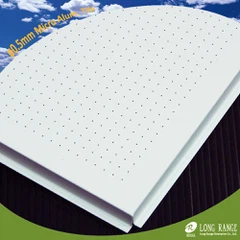
For example, in our tests, we've found that for a gypsum board with 12/20/35mm round holes, the maximum pressure it can withstand is significantly lower compared to a metal plate. The gypsum board is more brittle and has lower strength, so it fails at relatively lower pressures. You can find more information about our Gypsum Board 12/20/35R Round Hole on our website.


5. Application - Specific Considerations
The maximum pressure these round holes can withstand also depends on the specific application. In some applications, such as decorative panels, the pressure requirements are relatively low. These panels are mainly used for aesthetic purposes and may only need to withstand minor static loads.
In contrast, in industrial applications like pressure vessels or filters, the round holes need to withstand much higher pressures. In a pressure vessel, the holes may be subject to internal pressure from fluids or gases, and any failure of the holes can lead to serious safety hazards.
When designing products for different applications, we need to take into account the specific pressure requirements and select the appropriate materials and manufacturing processes accordingly.
6. Conclusion and Call to Action
In conclusion, determining the maximum pressure that 12/20/35mm round holes can withstand is a complex task that involves considering multiple factors, including material properties, hole geometry, manufacturing process, and application requirements. Through theoretical analysis and experimental testing, we can provide our clients with more accurate estimates of the pressure - bearing capacity of our products.
If you're interested in our 12/20/35mm round hole products and want to discuss your specific pressure requirements, please don't hesitate to contact us. We're committed to providing high - quality products that meet your needs and can offer professional advice on the best solutions for your applications.
References
- Timoshenko, S. P., & Goodier, J. N. (1970). Theory of Elasticity. McGraw - Hill.
- Shigley, J. E., & Mischke, C. R. (2001). Mechanical Engineering Design. McGraw - Hill.
Send Inquiry