

What is the sound - reflection coefficient of micro perforated aluminium ceiling tiles?
Nov 03, 2025
Leave a message
Hey there! I'm a supplier of Micro Perforated Aluminium Ceiling Tiles, and today I want to chat about the sound - reflection coefficient of these awesome products.
First off, let's get into what the sound - reflection coefficient actually is. In simple terms, it's a measure of how much sound gets reflected off a surface. When sound waves hit a material, some of it is absorbed, some is transmitted through, and the rest is reflected back. The sound - reflection coefficient tells us the proportion of the incident sound energy that gets reflected.
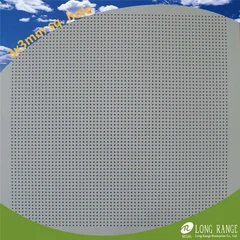
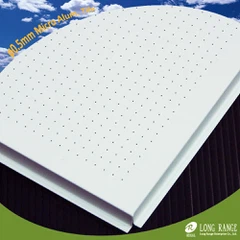
Now, for Micro Perforated Aluminium Ceiling Tiles. These tiles are pretty special when it comes to sound. The micro - perforations play a huge role in determining their sound - reflection coefficient. The small holes in the tiles create a kind of porous structure. When sound waves reach the tile, instead of just bouncing right off like they would on a solid surface, they enter these tiny perforations.
Inside the perforations, the sound waves interact with the air and the walls of the holes. This interaction causes the sound energy to be dissipated in the form of heat. As a result, less sound is reflected back, which means a lower sound - reflection coefficient.
The size, spacing, and depth of the micro - perforations are all factors that can affect the sound - reflection coefficient. For example, if the perforations are too large, the sound might not get trapped effectively, and more of it will be reflected. On the other hand, if the perforations are too small, the air movement inside them might be restricted, and the absorption of sound might not be as efficient.
Let's talk about some real - world applications. In spaces like recording studios, theaters, and concert halls, controlling sound reflection is crucial. Micro Perforated Aluminium Ceiling Tiles can be a great choice here. A low sound - reflection coefficient means that the sound in these spaces won't bounce around uncontrollably, which can lead to echoes and poor acoustics. Instead, the sound will be absorbed to a large extent, creating a more balanced and clear acoustic environment.
In office buildings, these tiles can also be beneficial. Open - plan offices can be noisy, with conversations and equipment sounds bouncing off hard surfaces. By installing Micro Perforated Aluminium Ceiling Tiles with a low sound - reflection coefficient, the overall noise level can be reduced, making the workspace more comfortable for employees.
Now, how do we measure the sound - reflection coefficient of these tiles? There are a few standard methods. One common way is to use an impedance tube. In this setup, a sound source emits sound waves into a tube, and the tile sample is placed at one end. Microphones are used to measure the incident sound and the reflected sound. By comparing the two, we can calculate the sound - reflection coefficient.
Another method is to conduct in - situ measurements in a real - world environment. This gives a more accurate representation of how the tiles will perform in an actual space. However, it can be more challenging to control all the variables in an in - situ measurement.
As a supplier of Micro Perforated Aluminium Ceiling Tile, I know that different customers have different requirements when it comes to the sound - reflection coefficient. Some might need a very low coefficient for a high - end recording studio, while others might be okay with a slightly higher one for a commercial space. That's why we offer a range of products with different perforation patterns and designs to meet these diverse needs.
We also understand that the sound - reflection coefficient is not the only factor to consider when choosing ceiling tiles. Durability, aesthetics, and cost are also important. Our Micro Perforated Aluminium Ceiling Tiles are not only great at sound absorption but also very durable. Aluminium is a strong and lightweight material that can withstand wear and tear over time. And in terms of aesthetics, we offer a variety of finishes and colors, so you can choose a tile that complements the interior design of your space.
If you're in the market for ceiling tiles and want to learn more about the sound - reflection coefficient and how it applies to your project, don't hesitate to reach out. Whether you're an architect, a contractor, or a building owner, we're here to help you make the right choice. We can provide you with samples, technical data, and even advice on installation.
In conclusion, the sound - reflection coefficient of Micro Perforated Aluminium Ceiling Tiles is an important aspect to consider when it comes to acoustic design. These tiles offer a great solution for controlling sound in various spaces, thanks to their unique perforated structure. If you're interested in our products, just drop us a line, and we'll start a conversation about how we can meet your specific needs.
References:


- Acoustics textbooks on sound absorption and reflection
- Industry standards for measuring sound - reflection coefficients
Send Inquiry