

What is the diffraction characteristic of a 12mm square hole?
Jan 12, 2026
Leave a message
Diffraction is a fundamental phenomenon in the field of wave physics, which occurs when waves encounter an obstacle or pass through an aperture. In this blog, we'll explore the diffraction characteristics of a 12mm square hole, a product we specialize in supplying.
Understanding Diffraction Basics
Before delving into the specific diffraction characteristics of a 12mm square hole, it's essential to understand the basic principles of diffraction. Diffraction is the bending and spreading of waves around obstacles or through openings. When a wavefront meets an aperture, the wavelets emerging from the edges of the aperture interfere with each other, creating a diffraction pattern.
The most well - known diffraction equation is the one related to single - slit diffraction. For a single slit of width (a), the angular position (\theta) of the (n)th minimum in the diffraction pattern is given by (\sin\theta = n\frac{\lambda}{a}), where (\lambda) is the wavelength of the incident wave and (n=\pm1,\pm2,\pm3,\cdots). However, a square hole is a two - dimensional aperture, and its diffraction pattern is more complex than that of a single slit.
Diffraction Pattern of a 12mm Square Hole
The diffraction pattern of a 12mm square hole can be analyzed using the Fraunhofer diffraction theory, which is applicable when the source of the waves and the observation screen are far enough from the aperture. In the case of a square hole of side length (L = 12mm), the intensity distribution (I(x,y)) in the diffraction pattern can be calculated using the following formula:
[I(x,y)=I_0\left(\frac{\sin(\beta_x)}{\beta_x}\right)^2\left(\frac{\sin(\beta_y)}{\beta_y}\right)^2]
where (\beta_x=\frac{\pi Lx}{\lambda z}) and (\beta_y=\frac{\pi Ly}{\lambda z}), (x) and (y) are the coordinates on the observation screen, (z) is the distance between the aperture and the screen, (\lambda) is the wavelength of the incident wave, and (I_0) is the intensity at the center of the diffraction pattern.
The diffraction pattern of a square hole consists of a central bright spot surrounded by a series of concentric and cross - shaped dark and bright fringes. The central maximum is the brightest part of the pattern, and its size is related to the wavelength of the incident wave and the size of the aperture. As the wavelength (\lambda) increases or the side length (L) of the square hole decreases, the central maximum becomes larger, and the diffraction effects become more pronounced.
Factors Affecting the Diffraction of a 12mm Square Hole
Wavelength of the Incident Wave
The wavelength of the incident wave has a significant impact on the diffraction pattern. For example, in the case of light waves, different colors (corresponding to different wavelengths) will produce different diffraction patterns. Blue light ((\lambda\approx450 - 495nm)) has a shorter wavelength compared to red light ((\lambda\approx620 - 750nm)). When passing through a 12mm square hole, the diffraction pattern of red light will have a larger central maximum and more spread - out fringes compared to that of blue light.
Distance from the Aperture to the Observation Screen
The distance (z) between the 12mm square hole and the observation screen also affects the diffraction pattern. As (z) increases, the diffraction pattern spreads out more. The size of the fringes and the central maximum is proportional to the distance (z). If we move the screen further away from the aperture, we can observe more details of the diffraction pattern, such as the higher - order fringes.
Incident Angle of the Wave
The incident angle of the wave on the 12mm square hole can also change the diffraction pattern. When the wave is incident at an angle (\theta_i) with respect to the normal of the aperture, the phase relationship between the wavelets emerging from different parts of the aperture changes. This results in a shift and distortion of the diffraction pattern.


Applications of 12mm Square Hole Diffraction
In Optics
In optical systems, 12mm square holes can be used as apertures in cameras, telescopes, and microscopes. The diffraction characteristics of these holes help in controlling the amount of light entering the system and in shaping the point - spread function. By carefully selecting the size and shape of the aperture, we can improve the image quality and resolution of the optical system.
In Acoustics
In acoustics, 12mm square holes can be used in sound - diffusing panels. The diffraction of sound waves through these holes helps in scattering the sound energy in different directions, reducing echoes and improving the acoustic quality of a room.
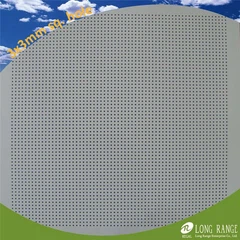
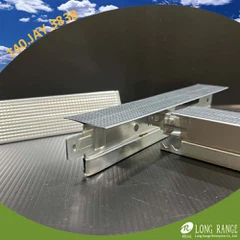
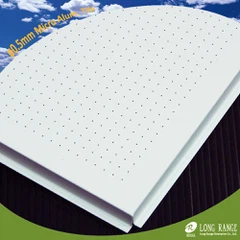
As a supplier of Gypsum Board 12x12mm Square Hole, we understand the importance of these diffraction characteristics in various applications. Our high - quality gypsum boards with 12mm square holes are carefully manufactured to ensure consistent and accurate diffraction performance.
Quality Assurance of Our 12mm Square Hole Products
We use advanced manufacturing techniques to produce 12mm square holes with high precision. The side length of the square holes is controlled within a very small tolerance range, ensuring that the diffraction characteristics are consistent from one product to another. Our quality control team conducts rigorous inspections at every stage of the manufacturing process to guarantee the quality of our products.
Why Choose Our 12mm Square Hole Products
- Precision Manufacturing: Our 12mm square holes are manufactured with high precision, which is crucial for achieving the desired diffraction effects in different applications.
- High - Quality Materials: We use high - quality gypsum materials in our products, which not only ensure the mechanical strength of the boards but also have good acoustic and optical properties.
- Customization Options: We can customize the size, shape, and density of the square holes according to your specific requirements. Whether you need a single 12mm square hole or a panel with multiple holes, we can meet your needs.
If you are interested in our Gypsum Board 12x12mm Square Hole products or have any questions about the diffraction characteristics of 12mm square holes, please feel free to contact us for procurement and further discussions. We are committed to providing you with the best products and services.
References
- Hecht, Eugene. "Optics." Addison - Wesley, 4th edition, 2002.
- Halliday, David, Robert Resnick, and Jearl Walker. "Fundamentals of Physics." Wiley, 10th edition, 2014.
Send Inquiry