


What is the surface roughness of a 6mm round hole?
Jul 03, 2025
Leave a message
Hey there! As a supplier of 6mm round holes, I often get asked about the surface roughness of these holes. It's a crucial factor that can impact the performance and functionality of the products where these holes are used. So, let's dive right in and explore what surface roughness of a 6mm round hole really means.
First off, what is surface roughness? Well, it's basically a measure of the texture of a surface. In the case of a 6mm round hole, it refers to the irregularities on the inner surface of the hole. These irregularities can be microscopic peaks and valleys, and they can vary in size, shape, and distribution.
Surface roughness is usually quantified using parameters like Ra (arithmetical mean deviation of the profile), Rz (mean height of the profile irregularities), and others. Ra is one of the most commonly used parameters. It gives an average value of the vertical deviations of the surface profile from the mean line over a specified sampling length. For a 6mm round hole, the Ra value can tell us how smooth or rough the inner surface is.
Why does surface roughness matter for a 6mm round hole? There are several reasons. For starters, if the hole is used for a precision fit, say for inserting a pin or a shaft, a smooth surface with low surface roughness is essential. A rough surface can cause excessive friction, which may lead to wear and tear of the inserted component over time. This can affect the accuracy and longevity of the assembly.
On the other hand, in some applications, a certain level of surface roughness might be desirable. For example, if the hole is used for fluid flow, a slightly rough surface can actually enhance the turbulence of the fluid, which can be beneficial in some heat transfer or mixing processes.
Now, let's talk about how the surface roughness of a 6mm round hole is achieved. There are various manufacturing processes that can influence the surface roughness. Drilling is one of the most common methods for creating 6mm round holes. However, the type of drill bit, the drilling speed, and the feed rate can all affect the final surface roughness. A high - speed drill with a sharp bit and an appropriate feed rate is more likely to produce a smoother surface compared to a dull bit or improper drilling parameters.
Another process is reaming. Reaming is a finishing operation that can be used after drilling to improve the surface finish of the hole. A reamer removes a small amount of material from the inner surface of the hole, reducing the surface roughness and improving the dimensional accuracy.
Grinding is yet another option for achieving a very smooth surface finish. It's a more precise and time - consuming process, but it can produce extremely low surface roughness values. This is often used in high - precision applications where a very smooth hole surface is required.
As a supplier of 6mm round holes, we understand the importance of providing the right surface roughness according to the customer's requirements. We have a team of experts who are well - versed in different manufacturing processes and can control the surface roughness to meet specific needs. Whether you need a smooth surface for a precision fit or a slightly rough surface for a special application, we've got you covered.
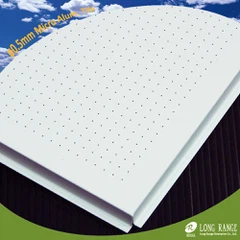
When it comes to the applications of 6mm round holes, they are quite diverse. In the automotive industry, these holes can be used in engine components, transmission parts, and suspension systems. In the electronics industry, they can be found in printed circuit boards for mounting components. And in the construction industry, Gypsum Board 6mm Round Hole is a popular product where these holes are used for aesthetic and functional purposes, such as sound absorption.
In the aerospace industry, the requirements for surface roughness of 6mm round holes are extremely strict. The components used in aircraft need to be highly reliable and precise, and the surface finish of the holes can directly affect the performance and safety of the aircraft.
To measure the surface roughness of a 6mm round hole, there are specialized instruments available. Profilometers are commonly used to measure the surface profile and calculate the surface roughness parameters. These instruments can provide accurate and detailed information about the surface texture of the hole.


We also conduct regular quality control checks to ensure that the surface roughness of our 6mm round holes meets the specified standards. Our quality control team uses advanced measurement techniques and equipment to verify the surface finish of each hole before it is shipped to the customer.
If you're in the market for 6mm round holes, whether it's for a small - scale project or a large - scale industrial application, we're here to help. We can provide you with high - quality holes with the right surface roughness for your specific needs. We're open to discussing your requirements in detail and coming up with the best solution for you.
Contact us to start the procurement process and let's have a chat about how we can meet your 6mm round hole needs. We're confident that our products and services will exceed your expectations.
References
- Fundamentals of Manufacturing Processes by Amitabha Ghosh and Ashok Kumar Malik
- Manufacturing Engineering and Technology by Serope Kalpakjian and Steven Schmid
Send Inquiry